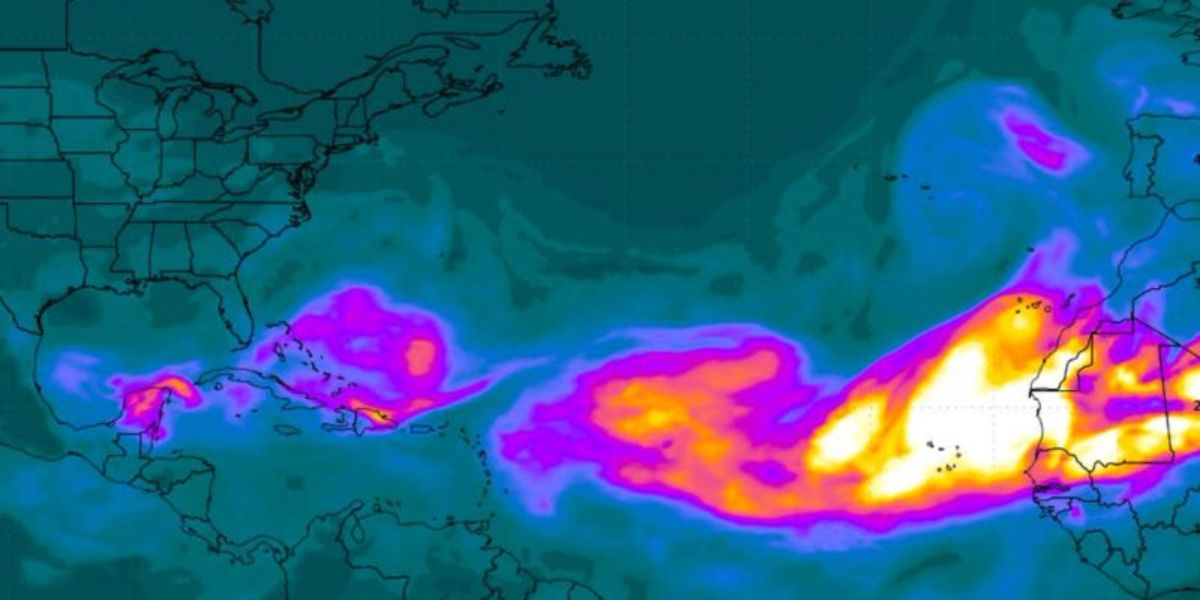
MIAMI, FL — A massive Saharan dust plume has moved off the coast of West Africa and is now tracking westward across the Atlantic Ocean, on a direct path toward the Caribbean Sea, the Gulf of Mexico, and the southeastern United States.
A Plume Thousands of Miles Wide
Satellite imagery confirms the dust as a dense, continuous stream spanning the entire tropical Atlantic corridor — from the West African coastline all the way into the Caribbean near the Bahamas and the Yucatan Peninsula. The most concentrated areas of dust appear in the central Atlantic, where conditions are thickest. Scientists describe the current outbreak as significant, both in scale and intensity.
Hurricane Season Just Got Interrupted
Saharan dust is one of nature’s most effective storm suppressants. The dry, stable air carried within these plumes strips tropical waves of the humidity and atmospheric instability they need to develop into organized storms. With this plume now blanketing such a wide portion of the Atlantic, meteorologists say any tropical waves trying to form or strengthen in the region will face a difficult environment in the coming days. The effect is a known seasonal pattern — dust outbreaks are common during the early and middle portions of hurricane season before typically tapering off as summer progresses.
What Residents Can Expect to See
For people living across the Caribbean, Gulf Coast states, and the southeastern US, the most visible sign of the plume’s arrival will be the sky itself. Dust particles suspended high in the atmosphere scatter sunlight at different wavelengths, producing deeper oranges, vivid reds, and rich pink hues at sunrise and sunset. Some residents may also notice a slight haze or milky quality to the daytime sky as the plume passes overhead.
Meteorologists are actively tracking the plume’s movement and will continue monitoring its impact on any developing tropical systems over the coming days.