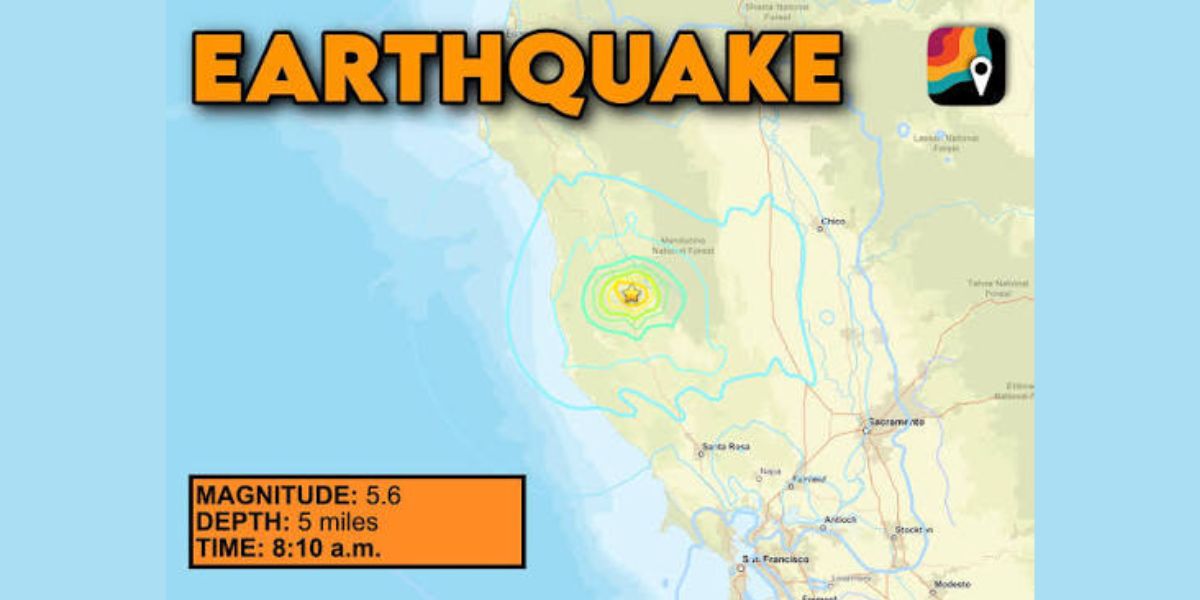
A magnitude 5.6 earthquake shook Redwood Valley, California at 8:10 a.m. Wednesday, catching residents across Northern California off guard during the early morning hours — and exposing a stark reality about how little time some communities have to protect themselves when the ground starts moving.
The quake struck at a shallow depth of just 5 miles, a detail that matters. Shallow earthquakes release their energy closer to the surface, meaning the shaking hits harder and faster than deeper events of the same magnitude.
Seconds That Could Save Your Life
The ShakeAlert wireless emergency alert system activated immediately after the strike, sending warnings to communities in the shaking zone. But the gap between those warnings was striking.
Ukiah, sitting closest to the epicenter, received just 1.6 seconds of advance notice — barely enough time to drop, cover, and hold on. Santa Rosa, farther from the rupture zone, received 26.1 seconds of warning, a window that can mean the difference between life and death.
The Fault Behind the Shake
Wednesday’s event is linked to the Maacama Fault, the northernmost segment of the Hayward Fault and part of the broader San Andreas Fault system. It is a right-lateral strike-slip fault, meaning the earth’s crust slides horizontally past itself — and Wednesday’s quake carried an additional oblique motion, a slight diagonal push along the fault plane.
This fault does not sit still between earthquakes. It accumulates roughly 8 millimeters of creep every year, a slow but relentless buildup of tectonic stress beneath Mendocino County.
What Comes Next
Residents across Redwood Valley, Ukiah, and Santa Rosa are urged to remain alert for aftershocks in the hours and days ahead. Experts consistently warn that the first quake is not always the largest.
Northern California sits atop one of the most seismically active fault networks in the United States. Wednesday morning was a reminder that the ground here does not stay quiet for long.