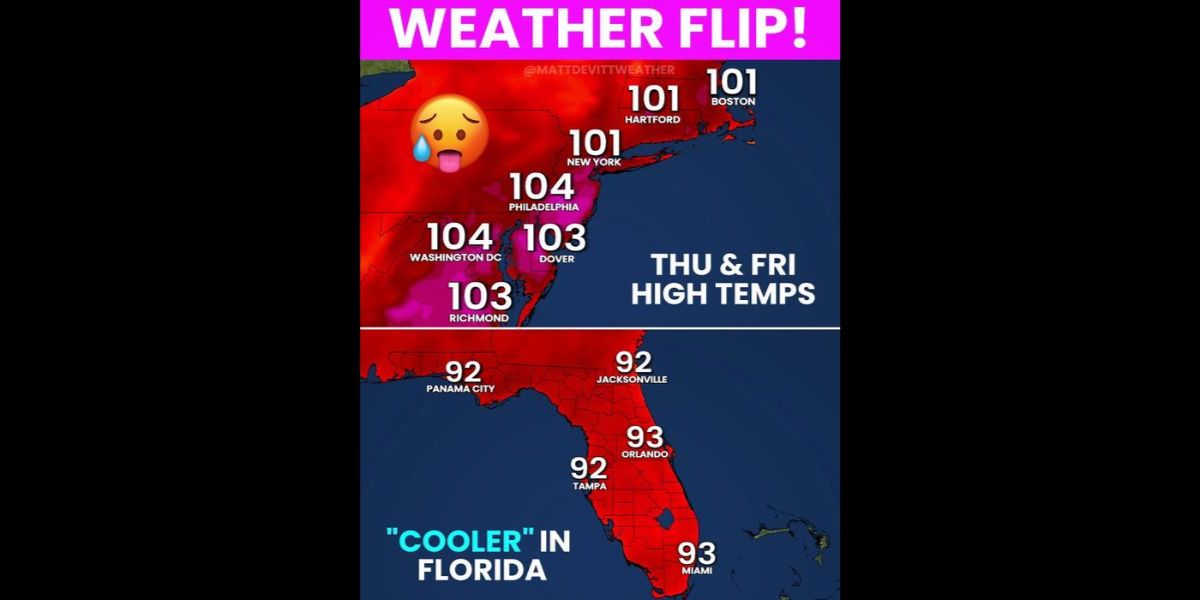
A dangerous and highly unusual heat pattern is taking hold across the Eastern United States this week, and the temperature map looks nothing like what Americans expect in early July. Cities across the Northeast corridor are forecast to be significantly hotter than anywhere in Florida on both Thursday and Friday — a reversal that meteorologists describe as a notable departure from typical summer conditions.
Washington D.C. and Philadelphia expected to reach 104 degrees
The nation’s capital and Philadelphia are forecast to top out at 104 degrees on both days, making them among the hottest major cities in the country this week. Dover, Delaware, and Richmond, Virginia, are each expected to reach 103 degrees. New York City, Boston, and Hartford are all forecast to hit 101 degrees — meaning the entire stretch from Boston to Washington is projected to see triple-digit heat for two consecutive days.
Northeast — hotter
Washington D.C. — 104°F
Philadelphia — 104°F
Dover / Richmond — 103°F
NYC / Boston / Hartford — 101°F
Florida — cooler this week
Orlando — 93°F
Miami — 93°F
Jacksonville — 92°F
Tampa / Panama City — 92°F
Florida running 9 to 12 degrees cooler than the Mid-Atlantic
Florida, which typically ranks among the hottest states in the country during summer, is forecast to see considerably lower temperatures than the Northeast this week. Orlando and Miami are both expected to reach 93 degrees, while Jacksonville, Tampa, and Panama City are forecast around 92 degrees — putting the Sunshine State nearly 12 degrees cooler than Washington D.C. and Philadelphia.
A heat dome centered over the Mid-Atlantic is driving the reversal
The unusual pattern is being driven by a heat dome — a high-pressure system that traps hot air and prevents it from escaping — parked directly over the Mid-Atlantic and Northeast regions. Unlike Florida’s typical summer heat, which is moderated by humidity and sea breezes, the heat dome is intensifying temperatures inland across a region far less adapted to this level of extreme heat.
Residents across the Northeast corridor are urged to take the threat seriously. Health officials recommend staying hydrated, limiting outdoor activity during peak afternoon hours, checking on elderly neighbors, and seeking air-conditioned spaces whenever possible. This level of heat can become life-threatening, particularly for those without access to cooling.