TOLEDO, OHIO — A powerful and nearly stationary rain band streaming off Lake Erie has stalled directly over the Toledo area, triggering a high risk of flash flooding across eastern Lucas County and Ottawa County. Forecasters say the storm system is behaving in a way that is almost never seen outside of winter — and it is showing no signs of letting up.
A BAND THAT WILL NOT MOVE
Radar imagery shows a well-organized band of heavy rainfall stretching from near Monroe and Kingsville, Michigan, southeastward across the Toledo metro and into northern Ohio. Over the past two hours, the band has grown noticeably larger while moving very little, allowing rainfall to pile up repeatedly over the same neighborhoods and roadways.
Rainfall rates of 1 to 2 inches per hour are expected to continue through much of the morning within the band’s heaviest core. The most intense rainfall is concentrated just east of Toledo, where radar returns are showing yellow and orange signatures — the colors associated with the heaviest downpours.
WHY FORECASTERS SAY THIS IS RARE
Meteorologists are describing this event as a lake-enhanced rain band — a phenomenon that works almost identically to the winter lake-effect snow bands that batter the Great Lakes region every year. Instead of channeling cold, unstable air into snowfall, the moisture and atmospheric instability rising off Lake Erie are being funneled directly into a concentrated corridor of tropical-strength rain. Forecasters say this type of setup is incredibly rare during warm-weather months.
EASTERN LUCAS AND OTTAWA COUNTIES AT HIGHEST RISK
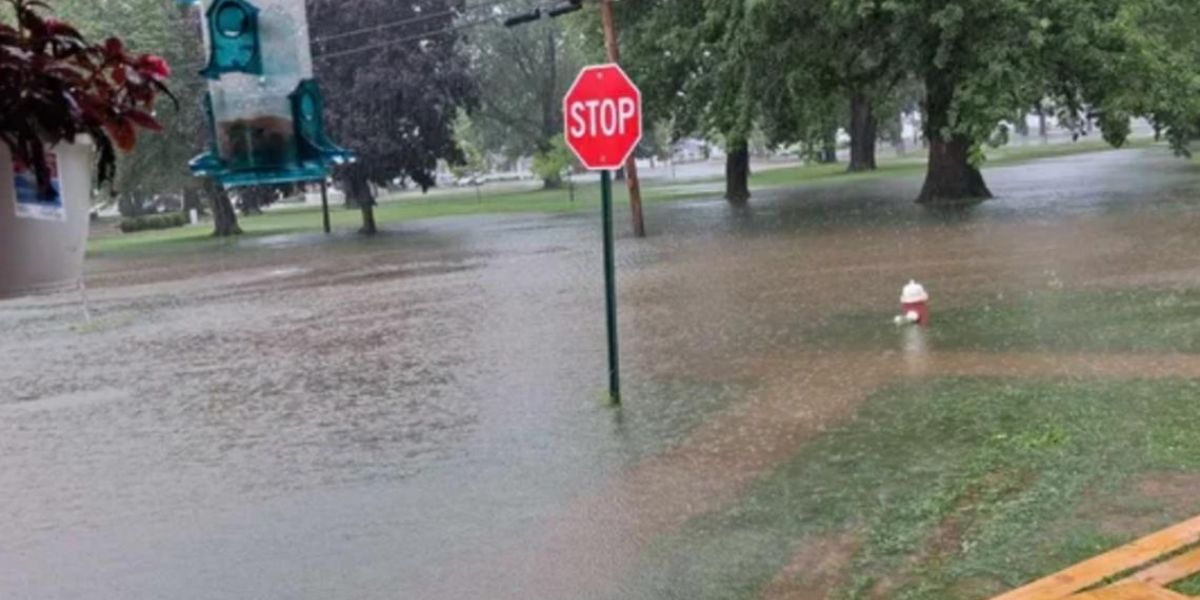
Residents in eastern Lucas County and Ottawa County face the greatest flash flood threat as the rain band continues to sit nearly stationary overhead. Officials are warning of flooded roads, water collecting in low-lying areas, and potential basement flooding as rainfall totals continue to climb. Lightning is also embedded within the band near Toledo, adding an additional hazard for anyone caught outside in the heaviest rainfall.
Residents are urged to avoid all flooded roadways, stay away from drainage ditches, and monitor local emergency alerts. Turn around, don’t drown — no road is worth your life.